
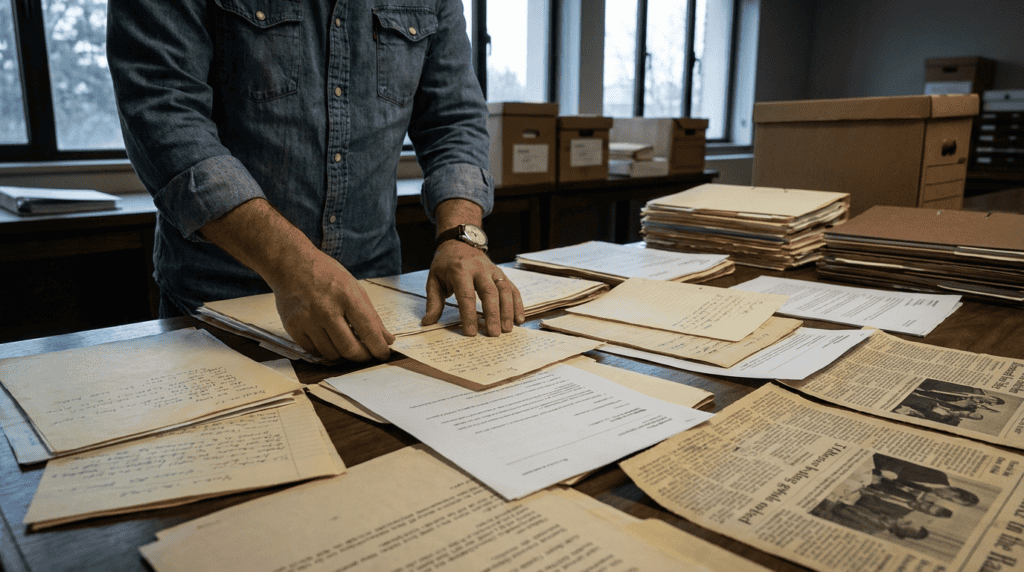
Investigative reporting often begins with fragments: a complaint, a tip, a rumor, an unexplained delay, a missing document, or a line in a report that does not seem to fit the official story. The work of the investigation is to turn those fragments into something the public can actually evaluate. That means gathering records, building timelines, testing claims, and showing how the evidence connects. At its best, investigative reporting does not just reveal a problem. It assembles a public record that would not exist otherwise.
This is one reason serious investigations take time. Fragments are easy to misread in isolation. A single complaint may not mean much by itself. A missing notice may turn out to be clerical. A delayed response may have a reasonable explanation. But when fragments repeat, align, and survive scrutiny, they can reveal a deeper pattern. Investigative reporting is what makes that pattern visible.
The Office of the Inspector General at the U.S. Department of Justice reflects the broader logic behind this kind of work: oversight becomes stronger when concerns are documented, examined systematically, and assessed against evidence instead of assumption.
Fragments are not enough until they are tested
A weak investigation treats fragments like conclusions. A strong one treats them like starting points. The reporter has to ask what else would confirm or weaken the claim. Is there a record of the event? Are there other similar complaints? Does the timeline hold? Does the institution’s own documentation support or contradict the public explanation? These are the questions that move an investigation from anecdote toward accountability.
Without that discipline, fragment-based reporting becomes too vulnerable to error, exaggeration, or narrative drift.
The role of chronology
One of the fastest ways to make sense of scattered information is to build a clear sequence of events. Chronology turns disconnected details into a testable record. It reveals whether a warning came before or after a decision. It shows whether officials had more time to act than they later suggested. It helps distinguish an isolated mistake from a pattern of delay or minimization.
For readers, chronology is often what makes an investigation understandable. It gives structure to material that would otherwise feel chaotic.
Why documents often change the direction of the story
Interviews can point the way, but documents often decide whether the reporting can hold. A single email, inspection note, contract amendment, complaint log, or meeting record can shift the entire meaning of a story. Not because documents are always complete or neutral, but because they can pin a claim to time and process. That makes them harder to dismiss.
Sometimes documents confirm what sources suspected. Other times they complicate it. Both outcomes matter, because the goal is not to force a dramatic narrative. It is to produce a reliable one.
| Reporting fragment | What helps test it |
|---|---|
| Single complaint | Complaint history, internal response records |
| Tip from one source | Independent documentation or secondary sourcing |
| Unclear timeline | Emails, notices, meeting minutes, logs |
| Official denial | Internal records and prior public statements |
| Suspected pattern | Multiple incidents with comparable documentation |
Investigative reporting creates memory for the public
Institutions often benefit from fragmentation. Problems are spread across departments, complaints are handled separately, and public attention moves on before the full picture is assembled. Investigative reporting works against that forgetfulness. It gathers what is scattered and puts it into a form the public can revisit later. In that sense, an investigation does more than break a story. It creates public memory.
That matters because accountability usually gets weaker when the record is incomplete or too difficult to follow. Investigations help prevent that by preserving evidence and sequence in one place.
Why restraint matters as much as persistence
Good investigative work is not only persistent. It is restrained. It avoids claiming more than the evidence can support. It leaves room for uncertainty where uncertainty remains. It distinguishes between what appears likely and what can be shown clearly. That restraint makes the work stronger, not softer. Readers trust investigations more when they can see that the reporting was not trying to outrun its own proof.
A durable investigation is one that holds up not just on publication day, but after the scrutiny that follows.
Final thoughts
Investigative reporting turns fragments into a public record by doing the patient work of testing, documenting, and connecting what institutions often leave scattered. That process is slow for a reason. Public trust depends on it. When done well, investigative reporting gives the public something more valuable than a dramatic headline: a record strong enough to remember, revisit, and act on.

Leave a Reply