
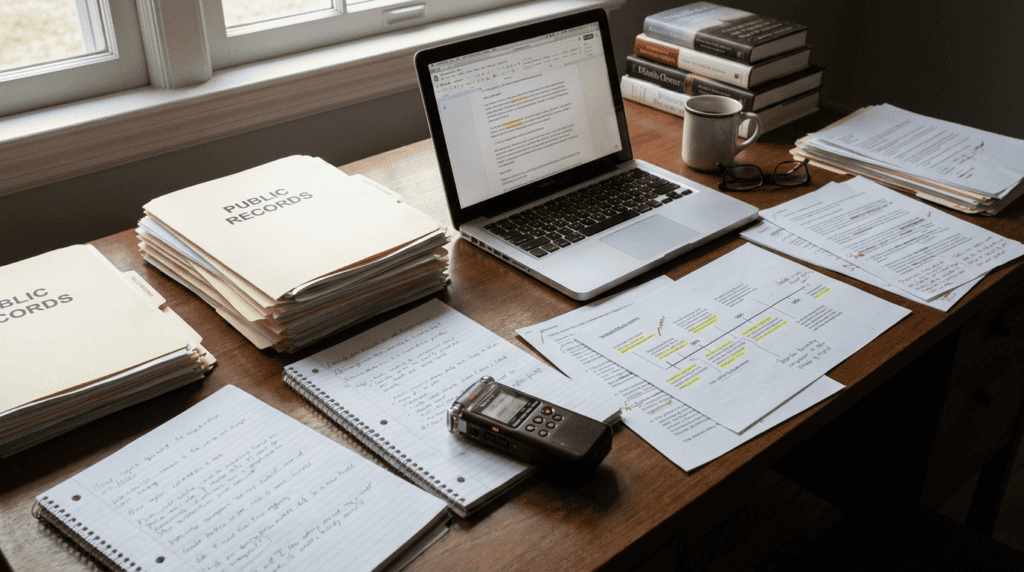
A strong public-interest investigation requires more than a compelling allegation. It needs documentation, timeline discipline, source care, and enough reporting depth to distinguish pattern from noise. The best investigations do not just expose that something went wrong. They show how it went wrong, who knew, what evidence supports the conclusion, and why the issue matters beyond one isolated incident.
That is what separates accountability journalism from commentary. A public-interest investigation is not simply about having a sharp angle or a dramatic opening. It is about building a record strong enough that readers can follow the evidence themselves. That means documents, interviews, chronology, institutional context, and careful attention to what is proven versus what is still uncertain.
The U.S. Department of Justice’s public fraud reporting resources reflect a basic principle that matters in journalism too: serious claims carry more weight when they are tied to evidence, dates, and identifiable conduct rather than broad accusation alone.
A strong investigation starts with a testable question
Good investigations rarely begin with a fully formed narrative. They begin with a question that can be tested. Was the public warned in time? Did officials ignore known risks? Was a contract awarded through a process that does not hold up to scrutiny? Did an institution’s public explanation match its private record? These are the kinds of questions that open investigative work up instead of narrowing it too early.
A weak investigation starts with a conclusion and tries to force every fact into it. A strong one stays open long enough to let evidence shape the story.
Documents matter because memory is imperfect
Interviews are crucial, but documents are often what keep an investigation from drifting into ambiguity. People forget. People protect themselves. People tell the story that feels safest in hindsight. Records, emails, memos, notices, audits, minutes, contracts, and logs can anchor a story when recollection gets blurry or strategic.
That does not mean every document is neutral. It does mean that documentary evidence helps establish a firmer baseline than recollection alone.
Timelines are where many investigations are won or lost
One of the most revealing tools in investigative reporting is the timeline. It forces institutions and events into sequence. When did the issue first surface? Who received the warning? When was the response drafted? Was there a delay between private awareness and public acknowledgment? Did action happen before or after public scrutiny intensified?
Many stories that look confusing at first become much clearer once the timeline is built carefully. Timelines expose gaps, contradictions, and patterns of delay better than rhetoric ever can.
| Investigation component | Why it matters |
|---|---|
| Documents | Anchor claims to evidence |
| Interviews | Add context, perspective, and institutional detail |
| Timeline | Shows sequence, delay, and decision points |
| Institutional context | Explains why the issue matters beyond one event |
| Clear sourcing standards | Helps readers trust what is confirmed |
Pattern matters more than drama
Some investigations fail because they overvalue the dramatic detail and undervalue the recurring pattern. But public-interest journalism is usually strongest when it reveals systems, not just spectacle. A dramatic anecdote can pull a reader in, but a documented pattern is what makes the reporting durable. Repeated warnings, recurring complaints, familiar procedural breakdowns, or consistent institutional behavior often matter more than one shocking moment.
That is especially true when the story involves public accountability. Readers need to understand not just what happened, but whether the problem is structural.
Precision builds trust
Strong investigations are careful about language. They distinguish between what is alleged, what is documented, what is confirmed, and what remains unclear. That precision is not a weakness. It is one of the main reasons readers trust serious reporting. An investigation should feel firm where the evidence is firm and honest where uncertainty remains.
That kind of discipline may look less dramatic than sweeping accusation, but it makes the reporting much harder to knock down later.
Final thoughts
A strong public-interest investigation requires patience, documentation, structure, and restraint. It has to do more than raise suspicion. It has to show readers why the claim holds up, how the evidence fits together, and why the findings matter beyond one headline cycle. That is what gives investigative work real civic value.

Leave a Reply